|
Messerschmitt Bf 110 F
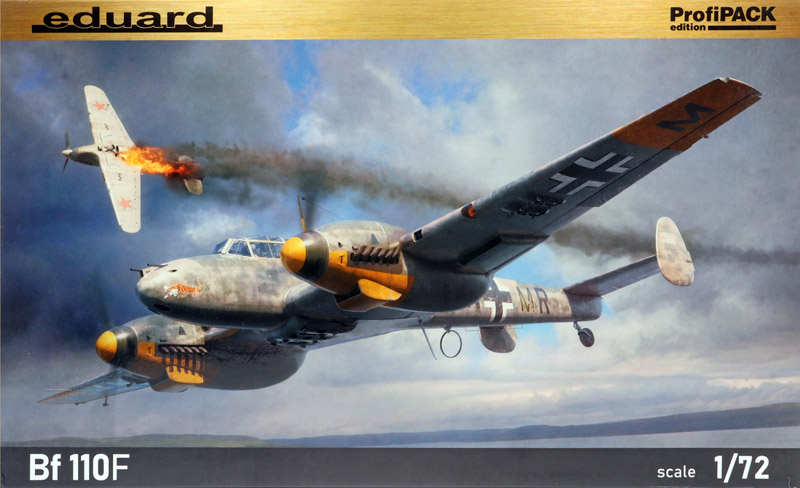
Eduard ProfiPACK, 1/72 scale
S
u m m a r y |
| Catalogue Number: |
Eduard Kit No. 7084 - Messerschmitt Bf 110 F ProfiPACK Edition |
| Scale: |
1/72 |
| Contents and Media: |
Arund 200 parts in grey coloured plastic; five parts in 3d printed resin; 13 parts in clear; colour photo-etched fret; self-adhesive die-cut masking sheet; markings for five aircraft |
| Price: |
USD$47.95 plus shipping,
available online from Eduard |
| Review Type: |
FirstLook |
| Advantages: |
Outstanding detail; thoughtfully engineered for easy construction; fine surface
features including crisply recessed panels and subtle rivet lines where
appropriate; includes colour photo-etched parts; separate parts for closed/open pilot's and gunner's canopies; high quality
plastic; narrow sprue attachments. .. |
| Disadvantages: |
|
| Conclusion: |
Eduard has clearly learned from the experience of its earlier 1/48 scale Bf 110 family.
This 1/72 scale Bf 110 F combines high moulding quality, beautifully restrained surface detail and an impressively comprehensive cockpit with thoughtful engineering that makes construction an enjoyable prospect.
The sturdy undercarriage, excellent clear parts and included masks are all welcome touches, while the colour photo-etched details add further refinement straight from the box. Add five attractive marking options, well-printed decals and plenty of useful spare parts, and there is very little to complain about. Having built Eduard’s earlier 1/72 scale Bf 110 E and G-2 kits, I can confidently say that the F continues the family tradition of combining outstanding detail with straightforward construction.
If you have been put off Eduard’s 1/48 scale Bf 110s by their reputation for tricky assembly, forget those preconceptions. This is a superb little Messerschmitt, an enjoyable build and a highly recommended addition to any 1/72 scale Luftwaffe collection |
Reviewed by Brett Green

The Messerschmitt Bf 110 F represented a significant refinement of the Luftwaffe’s twin-engined Zerstörer, evolving from the Bf 110 C, D and E variants that had seen service during the opening years of the Second World War. The C-series introduced the Daimler-Benz DB 601 engines and performed well during the campaigns in Poland, Norway and France, but the Bf 110’s limitations became obvious during the Battle of Britain, when its relatively poor manoeuvrability and lack of speed left it vulnerable to single-engined fighters.
The Bf 110 D addressed the requirement for greater range, including provision for large auxiliary fuel tanks, while the E introduced a strengthened airframe, additional armour and increased bomb-carrying capability. These improvements added weight, however, compromising performance.

The F-series sought to redress this problem by combining the strengthened structure and protection of the E with more powerful 1,350 hp Daimler-Benz DB 601F engines. The additional power restored much of the performance lost through the increasing weight of equipment and armour. The F also incorporated improved crew protection and standardised provision for external fuel tanks.
Introduced from mid-1941, the Bf 110F was produced in several forms, including the F-1 fighter-bomber, F-2 long-range fighter and F-3 reconnaissance aircraft. The F-4 was particularly significant as the first Bf 110 variant developed specifically as a night fighter, establishing the role in which the type would ultimately achieve its greatest success.
Although still slower and less manoeuvrable than contemporary single-engined fighters such as the Bf 109, the Bf 110F offered considerable range, firepower, stability and payload capacity. It was also intended as an interim design until the troubled Me 210 could take over its role. When the Me 210 failed to live up to expectations, however, the Bf 110 remained in production.
The subsequent Bf 110 G retained the basic F-series configuration but introduced DB 605 engines, revised aerodynamics, enlarged rudders and a redesigned nose and armament arrangement. Increasingly specialised equipment further extended its versatility.
The Bf 110 F therefore occupies an important place in the type’s evolution, restoring performance to the increasingly heavy airframe while establishing the configuration that led to the successful G-series night fighters.
Eduard released the first of their 1/48 scale Messerschmitt Bf 110 family back in September 2007. The kits are very well detailed and feature impressive surface textures; with plenty of useful options and attractive decals.
They also have a reputation of being tricky to build.
Eduard clearly took a good hard look at the engineering and parts breakdown of those 1/48 scale kits and made some changes when they were designing their 1/72 scale Messerschmitt Bf 110 family.
Having already built Eduard's 1/72 scale Messerschmitt Bf 110 E and Bf 110 G-2, I can report that construction was a very enjoyable experience. You can forget any preconceptions you might have about the 1/48 scale kits - this one should be viceless.
Eduard's 1/72 scale Messerschmitt Bf 110 F is moulded in medium grey plastic. The kit comprises 195 parts in grey coloured plastic, 13 parts in clear, a colour photo-etched fret, self-adhesive die-cut masking sheet; and markings for five aircraft.
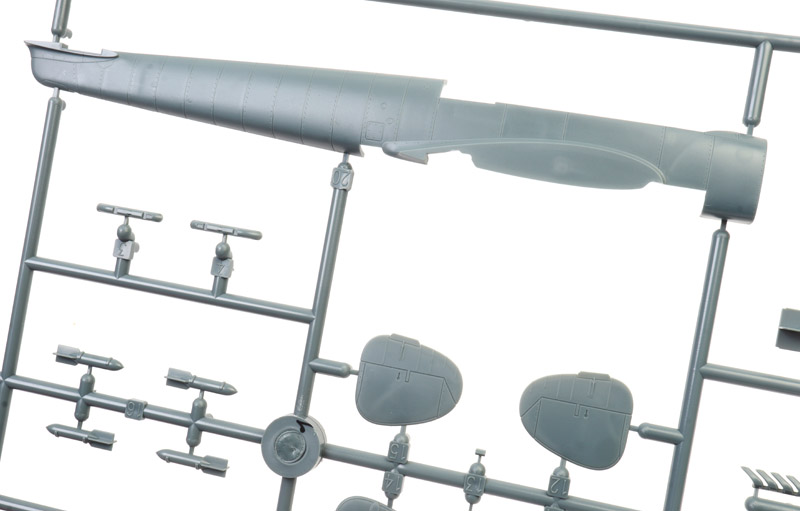
Many of the 195 grey plastic parts are marked "not for use" and will find their way to your spares box.
Eduard's 1/72 scale Bf 110 F shares a number of sprues with its predecessors, including the fuselage halves, wings and tailplanes.
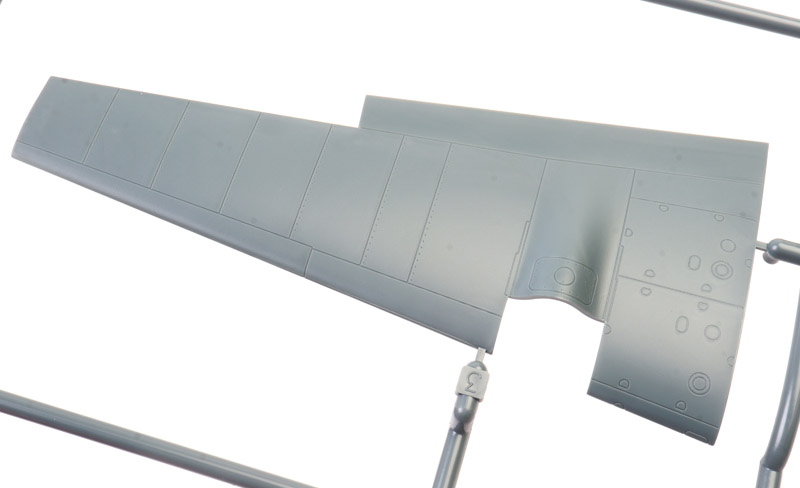
Moulding quality is superb. I could not find a single sink mark or ejector pin in any area that will be visible on the finished model.
Crisply recessed panel lines are partnered with beautifully subtle rows of rivets.
I like the treatment of the fabric control surfaces too, with delicately raised rib tape and no sagging in between.
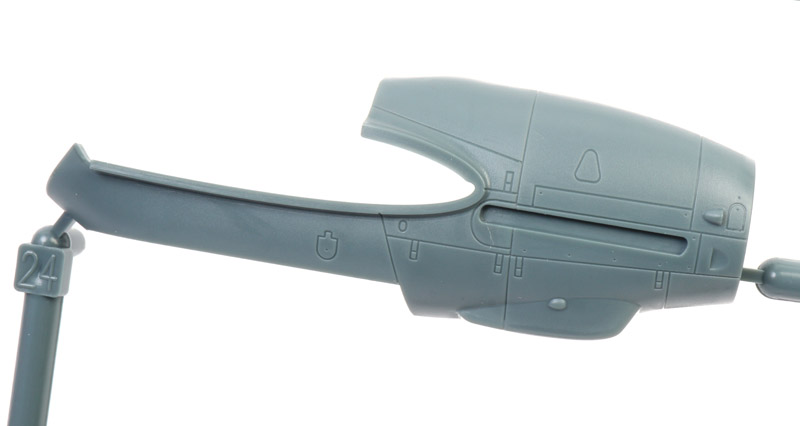
The fuselage is broken down into the main halves with a separate nose (upper and lower) plus an insert for the deck immediately aft of the cockpit.
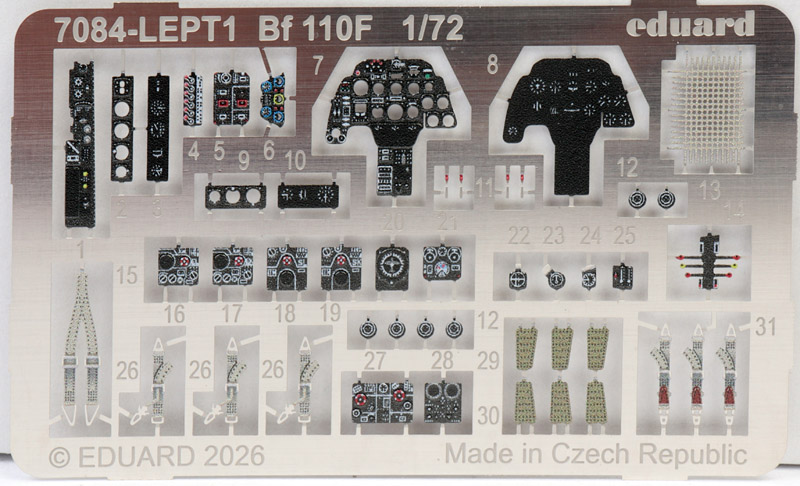
The cockpit is comprehensively fitted out with a combination of fine plastic and colour photo etched parts.
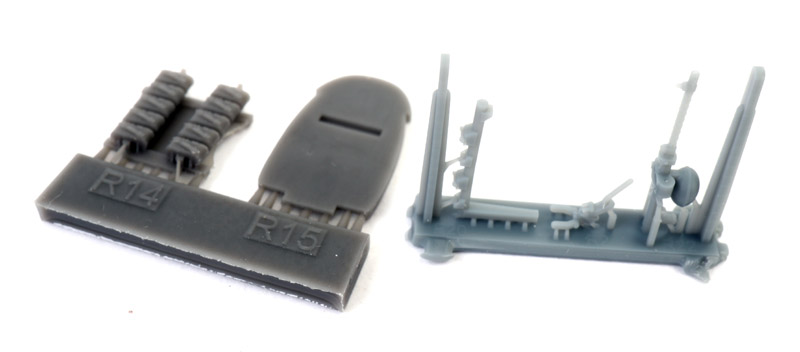
Also included are 3d printed ammo racks, ammo cans and a machine gun.
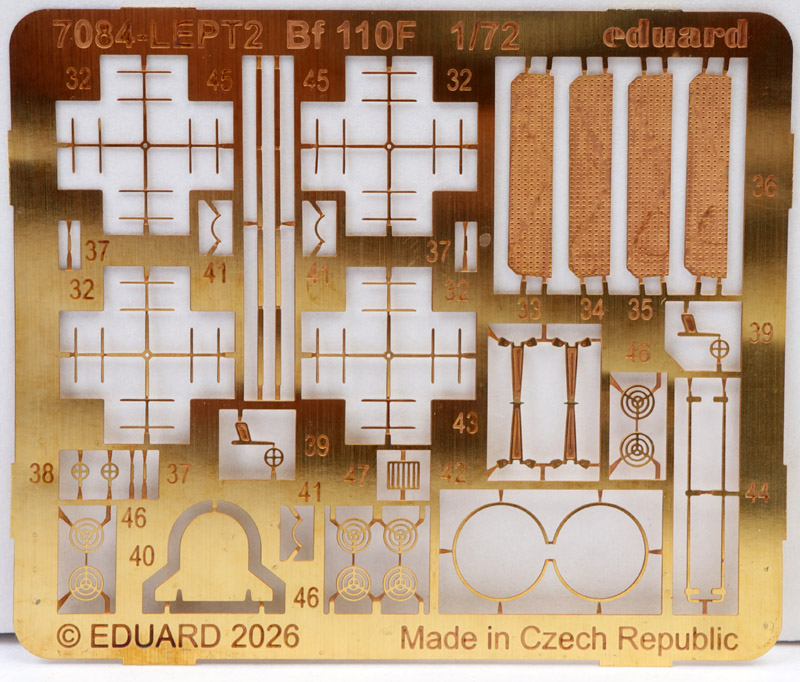
A brass photo-etched fret supplies the in-scale radar array and other exterior details.
Wheel well detail is moulded to the bottom of the wing and the inside of the nacelle parts. If you want to add more detail, Eduard has released a photo-etched fret that supplies the individual ribs inside the wheels wells. The main undercarriage legs are quite stout, with two locating pins to ensure correct positioning. Optional plastic and photo-etched oelo scissors are offered.
The shape of the nacelles and spinners look good.
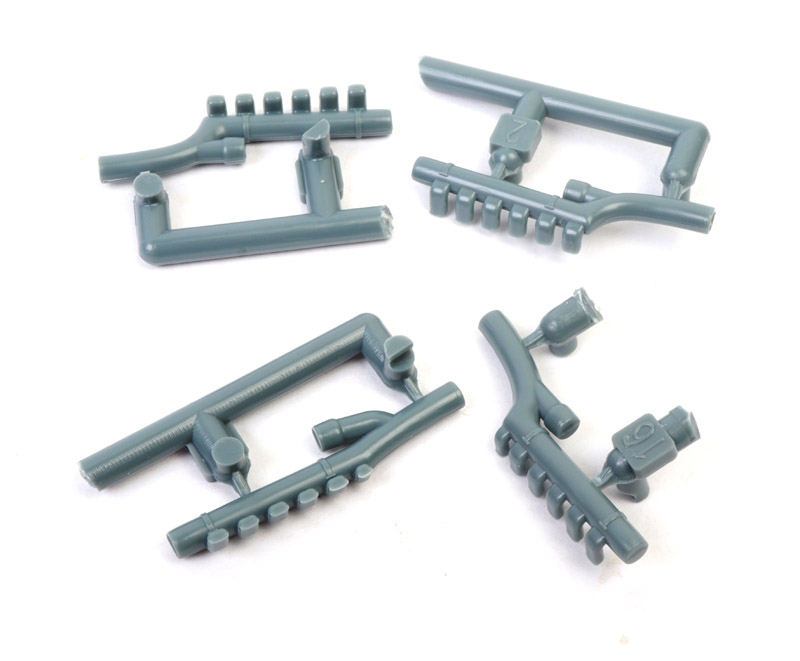
The exhausts are moulded as six-stack units with flame dampers, making assembly quite simple.
Clear parts are thin and well moulded. The pilot's and the gunner/radio operator's canopy hatches are both separate and may be posed open. Both early and late style canopies are on the sprues.
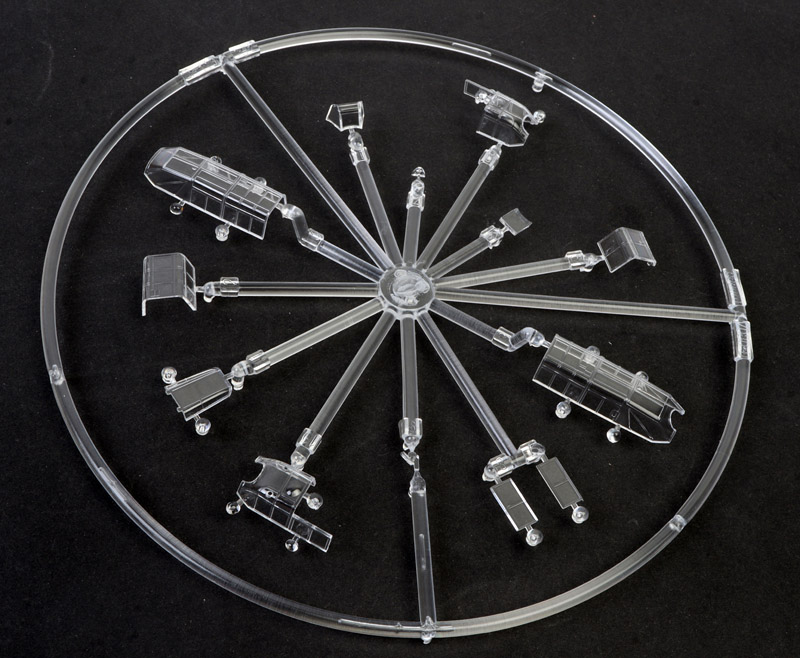
Eduard masks are included to ease the pain of painting that maze of canopy frames.
Decals for five marking options are included.
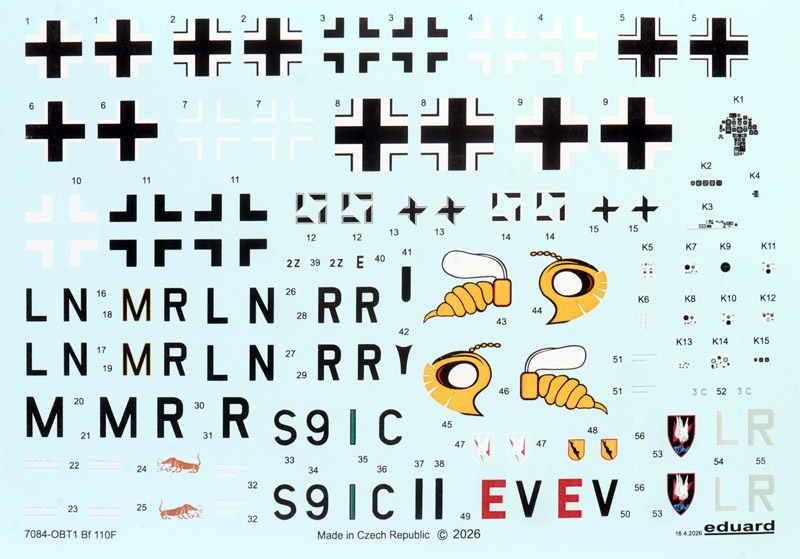
A small decal sheet provides stencils.
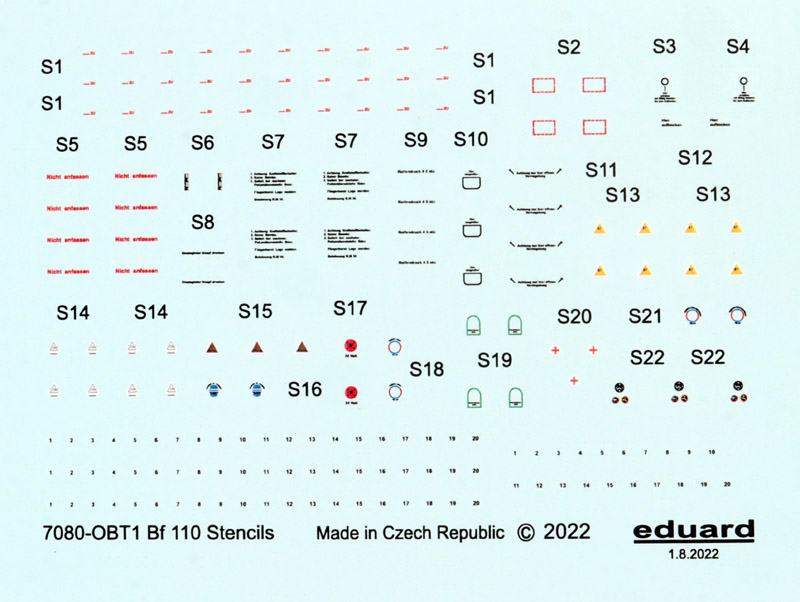
The decals are well-printed and in register. Stencil markings are included.
Eduard has clearly learned from the experience of its earlier 1/48 scale Bf 110 family.
This 1/72 scale Bf 110 F combines high moulding quality, beautifully restrained surface detail and an impressively comprehensive cockpit with thoughtful engineering that makes construction an enjoyable prospect.
The sturdy undercarriage, excellent clear parts and included masks are all welcome touches, while the colour photo-etched details add further refinement straight from the box.
Add five attractive marking options, well-printed decals and plenty of useful spare parts, and there is very little to complain about.
Having built Eduard’s earlier 1/72 scale Bf 110 E and G-2 kits, I can confidently say that the F continues the family tradition of combining outstanding detail with straightforward construction.
If you have been put off Eduard’s 1/48 scale Bf 110s by their reputation for tricky assembly, forget those preconceptions. This is a superb little Messerschmitt, an enjoyable build and a highly recommended addition to any 1/72 scale Luftwaffe collection.
Thanks to Eduard for the sample
Review Text Copyright © 2026 by
Brett Green
Page Created 2 October, 2026
Last updated
2 October, 2026
Back to HyperScale Main Page
Back to Reviews Page |
 Home
| What's New |
Features |
Gallery |
Reviews |
Reference |
Forum |
Home
| What's New |
Features |
Gallery |
Reviews |
Reference |
Forum |