|
Spitfire Mk.Vb Mid
ProfiPACK Edition
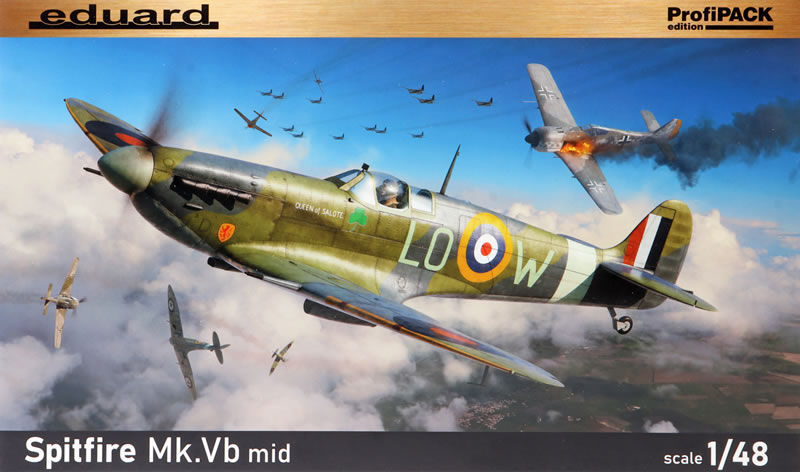
Eduard,
1/48 scale
S
u m m a r y |
| Catalogue Number: |
Eduard Kit No.82157 - Spitfire Mk. Vb ProfiPACK Edition |
| Scale: |
1/48 |
| Contents and Media: |
208 parts in grey plastic (65 marked “not for use”); 21 parts in clear plastic (8 marked "not for use"); colour photo-etched fret; marking options for seven aircraft; instructions. |
| Price: |
USD$54.95 plus shipping,
available online from Eduard
GBP£28.70 EU Price (GBP£23.92 Export Price) plus shipping available online from Hannants |
| Review Type: |
FirstLook |
| Advantages: |
High level of detail; outstanding surface features including crisply recessed panels and subtle raised and recessed rivet lines where appropriate; separate parts for different styles of closed and open canopies; many options for Spitfire Mks. I to V. |
| Disadvantages: |
None noted. |
| Conclusion: |
It is nice to see Eduard's gorgeous mid-production Spitfires in the luxurious ProfiPACKguise.
Eduard’s 1/48 scale Spitfire Mk.V kits are beautifully detailed, accurate, boast lovely fine surface textures and offers most of the options that you will ever need for this sometimes labyrinthine subject.
I have built a number of the ProfiPACK versions of Eduard Spitfires including the Vc and I can confirm that they are a pleasure to put together too.
Eduard’s 1:48 scale Spitfire family has been an instant classic since their initial Mk.IX release and these Mk.Vs maintain the high standard. |
Reviewed by Brett Green

The Supermarine Spitfire Mk.Vb represents one of those pivotal wartime types whose importance far outweighs the apparent simplicity of its origins. Conceived as an interim measure, the Mk.V was essentially a Spitfire Mk.I or II airframe adapted to accept the more powerful Rolls-Royce Merlin 45 series engine. In doing so, it ensured that the RAF retained a competitive front-line fighter at a moment when the air war threatened to tilt in Germany’s favour.
Introduced into squadron service in early 1941, the Mk.Vb was distinguished by its “b” wing, mounting two 20 mm Hispano cannon supplemented by four .303 Browning machine guns. This combination gave the Spitfire a formidable punch against bombers and fighters alike, while retaining the excellent handling and harmonious control response that had already made the Spitfire famous. At medium altitudes, the Mk.Vb was a match for most Axis opponents it encountered during 1941 and early 1942.
The type saw extensive service across multiple theatres. Over northern Europe it bore the brunt of offensive fighter sweeps and bomber escort duties, while in the Mediterranean and North Africa it became the RAF’s primary single-seat fighter, operating from primitive airstrips under harsh conditions. Mk.Vbs were also supplied in large numbers to Allied air arms, including those of Australia, Canada and the United States, spreading the Spitfire legend far beyond Britain.
The appearance of the Focke-Wulf Fw 190 exposed the Mk.Vb’s limitations, prompting rapid development of improved variants. Nevertheless, the Spitfire Mk.Vb had already fulfilled its critical role: bridging the gap between early-war designs and more advanced successors. In doing so, it secured its place as one of the most significant and widely used Spitfire variants of the Second World War.
Eduard debuted their Spitfire Mk.V kits in the Dual Combo Limited Edition "Eagles Call" boxing in August 2021, followed by their "Southern Star" boxing in February 2022.
The Mk.Vb is now making a return appearance in the next instalment of Eduard's Spitfire releases in the guise of a single 1/48 scale Spitfire Mk.Vb Mid Production in the ProfiPACK Edition..
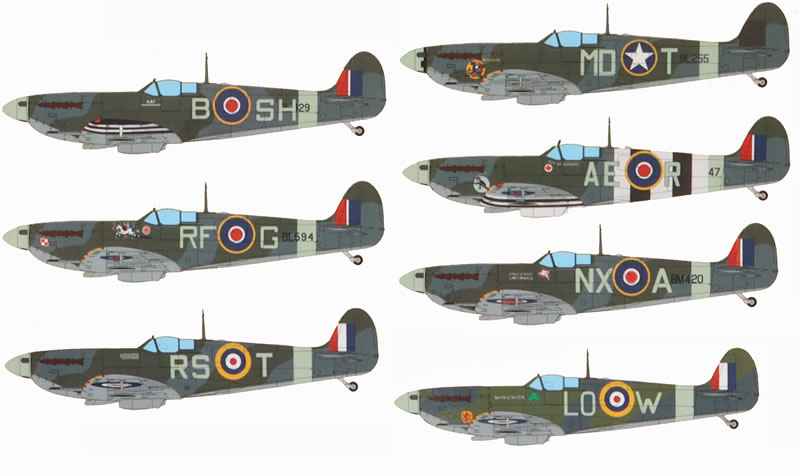
The ProfiPACK kits include photo-etch and masks. This one also boasts a generous seven marking options.
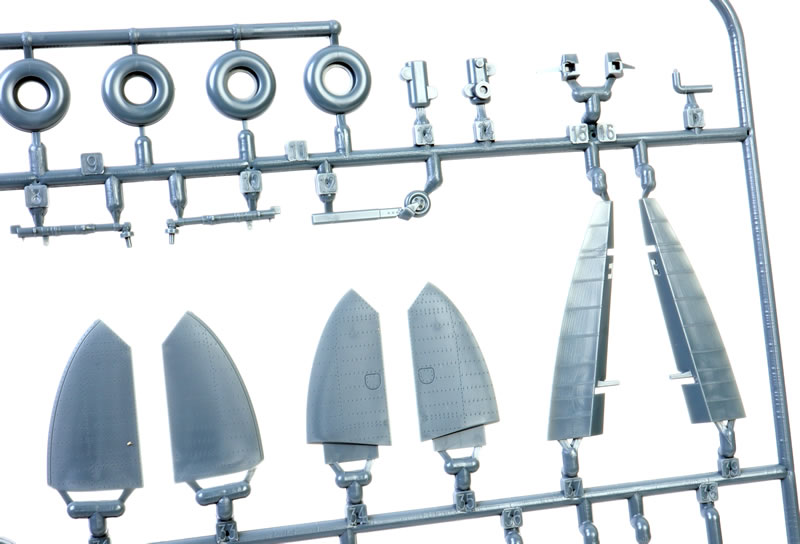
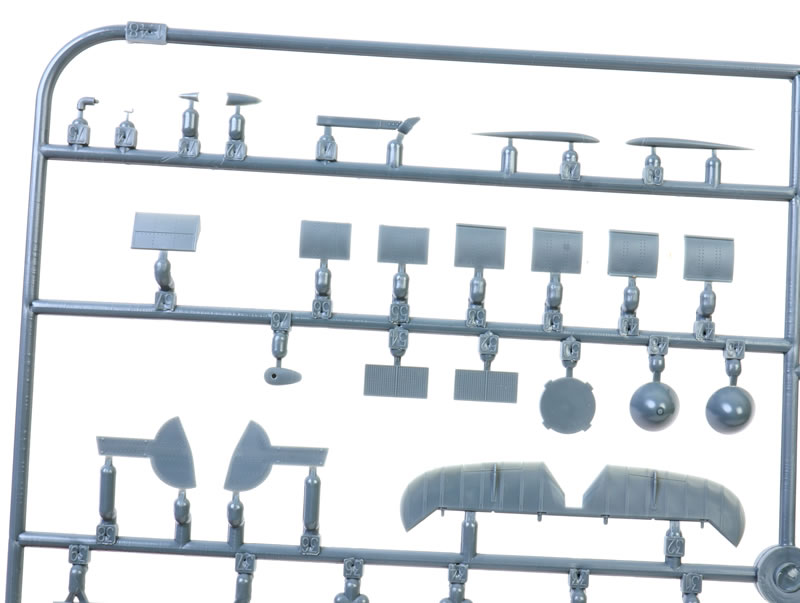
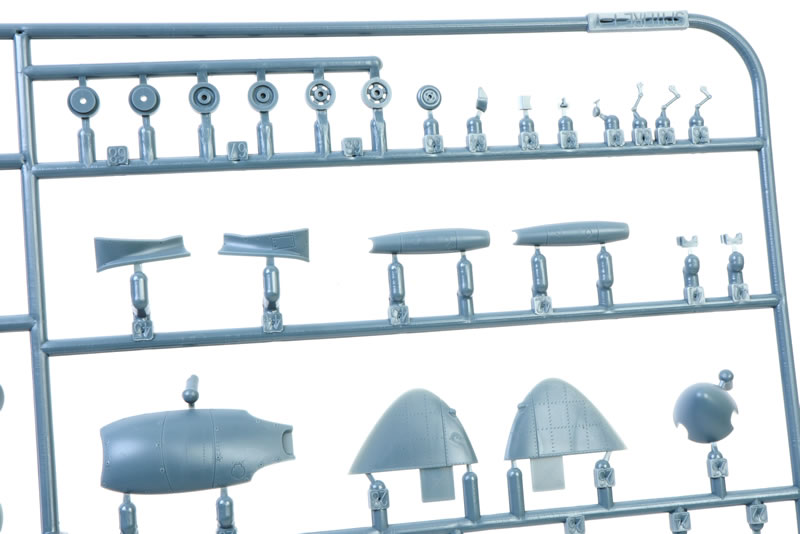
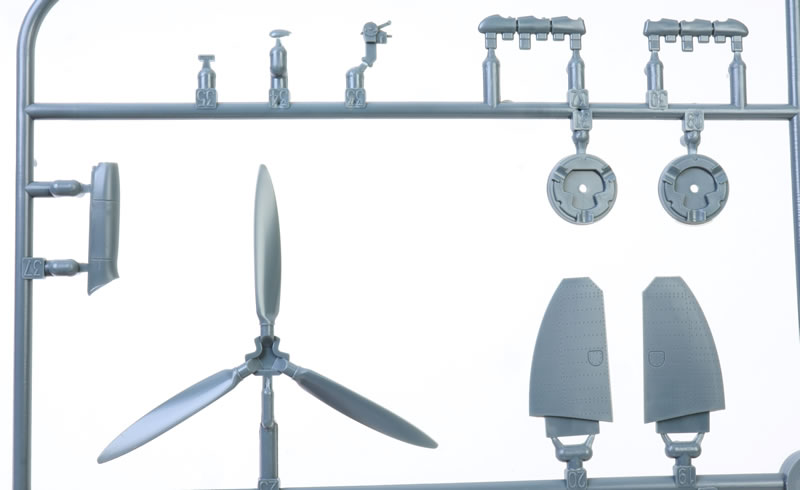
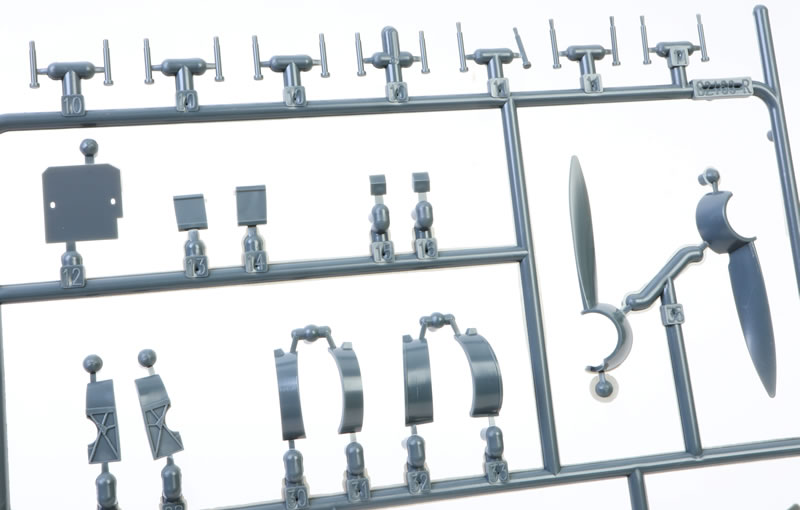
This ProfiPACK Spitfire Mk.Vb comprises 208 parts in grey plastic, 21 parts in clear plastic,a colour photo-etched fret; self-adhesive canopy and wheel masks; decals with seven marking options and instructions. More than 70 parts are marked “not for use” while many others are optional, further reducing the actual parts count.
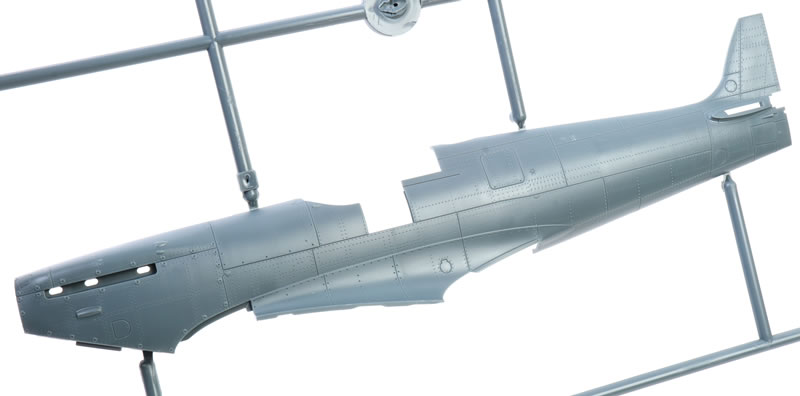
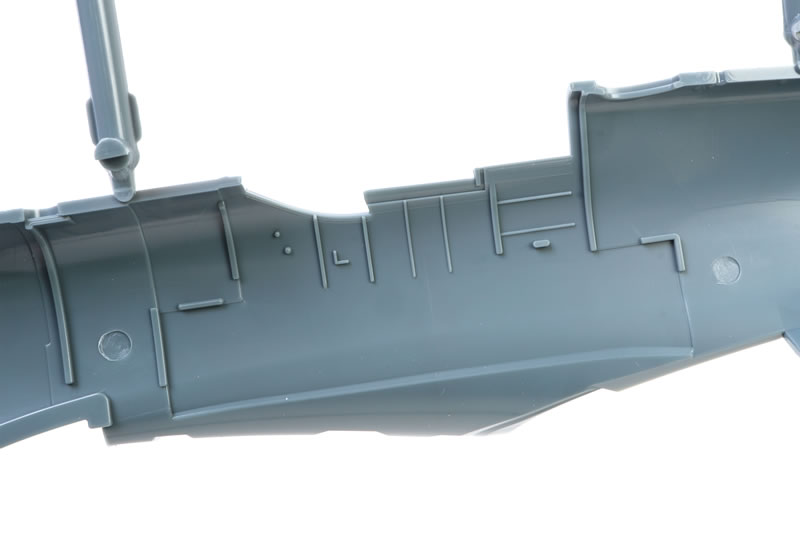
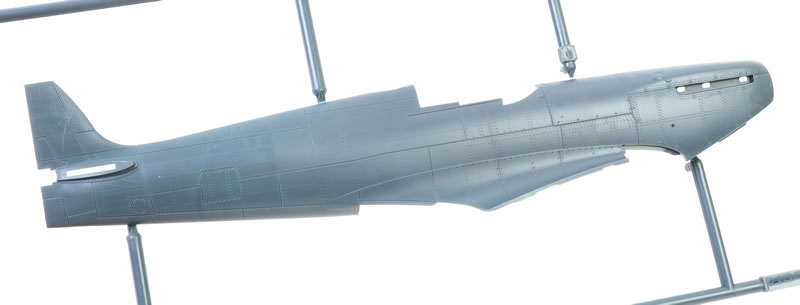
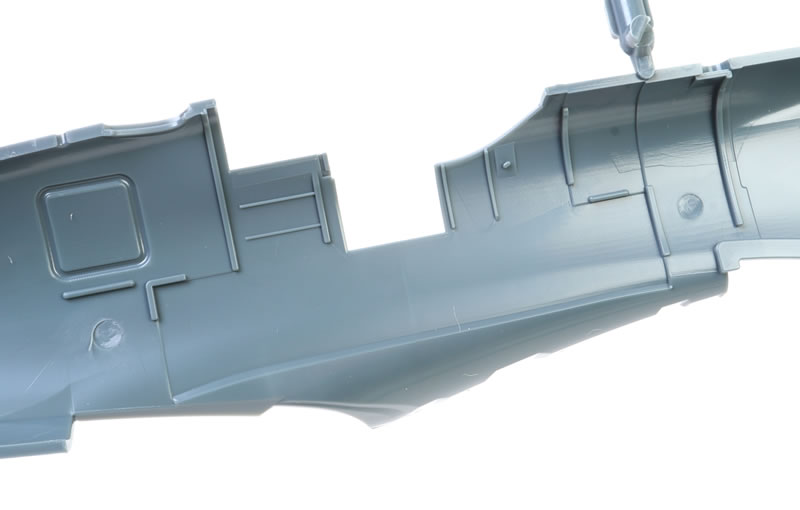
In this boxing the fuselage is labeled Sprue C. Sprue C represents the earlier Mk.V with the external armoured windscreen glass..
The recessed area at the front of the opening for the windscreen on this fuselage is deeper than the later versions too.
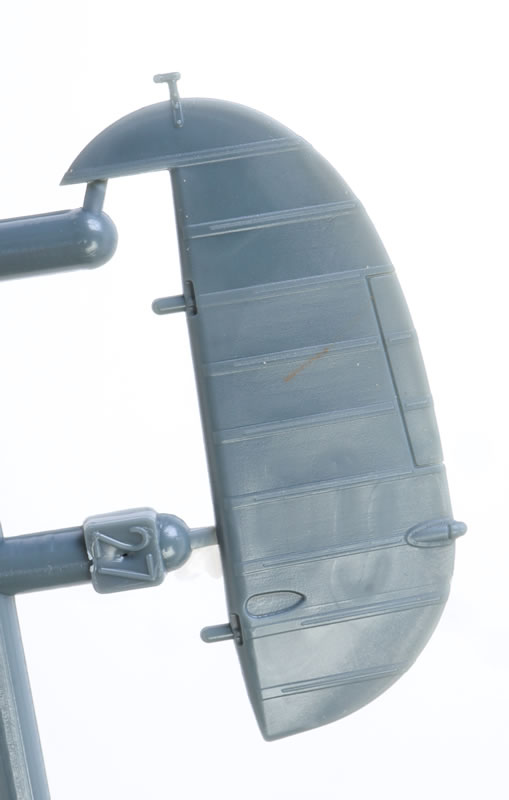
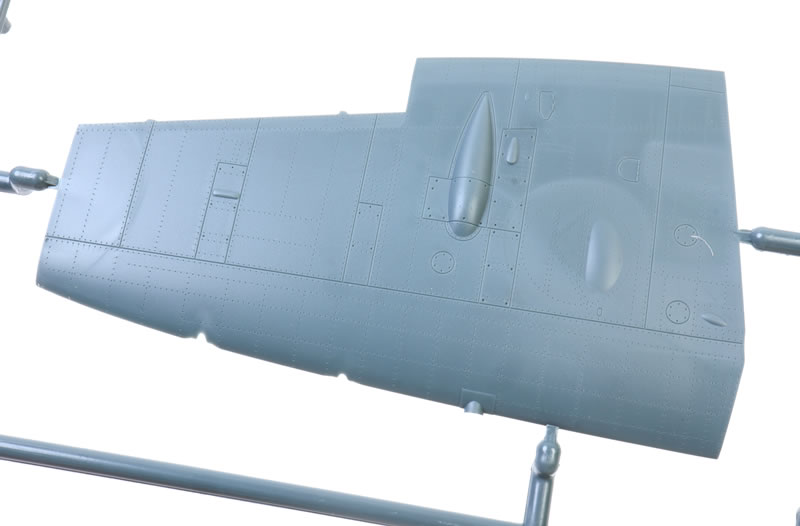
Next we have the wings. The wing sprue for the Mk.Vb is labelled differently for the upper and lower wings – Sprue L for the upper wings and Sprue M for the lower.
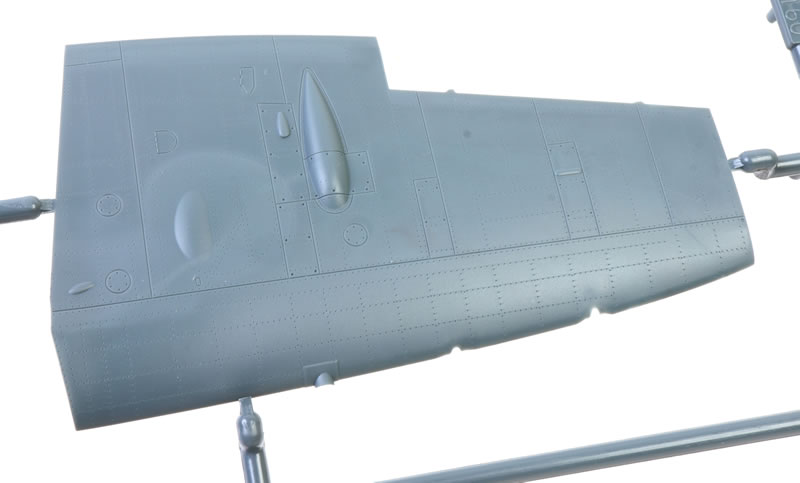
Sprue M captures the specific attributes of the Mk.Vb cannon bulges and the arrangement of several panel lines and hatches.
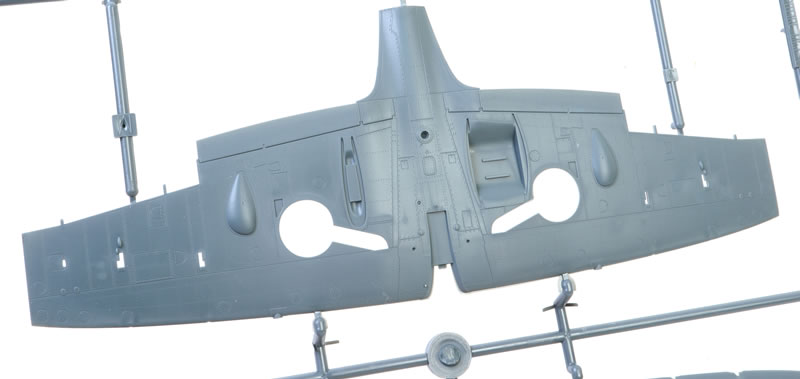
This is really nice attention to detail.
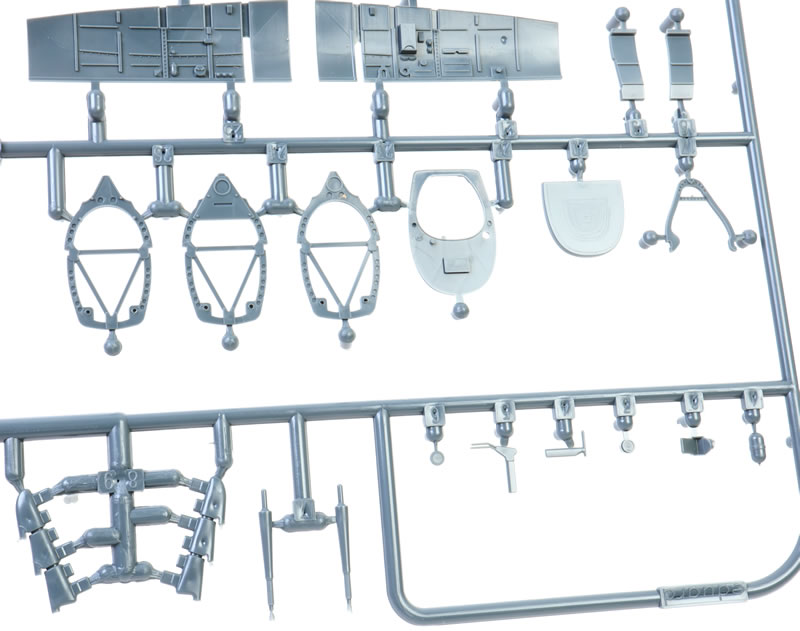
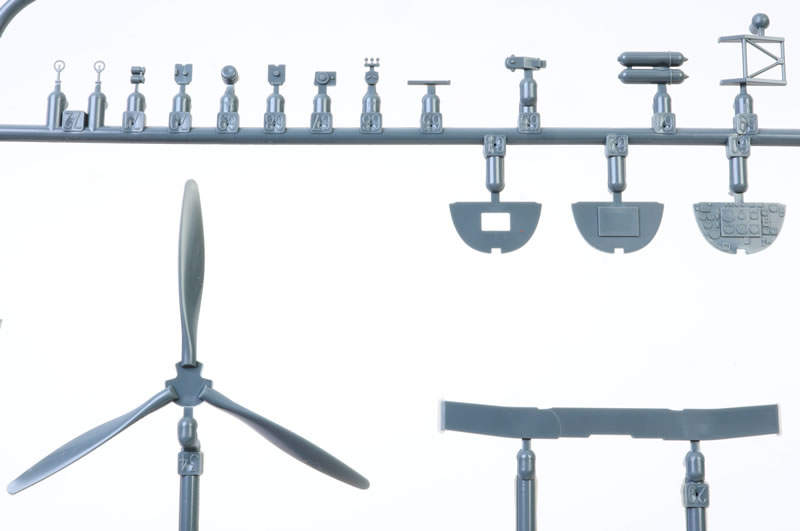
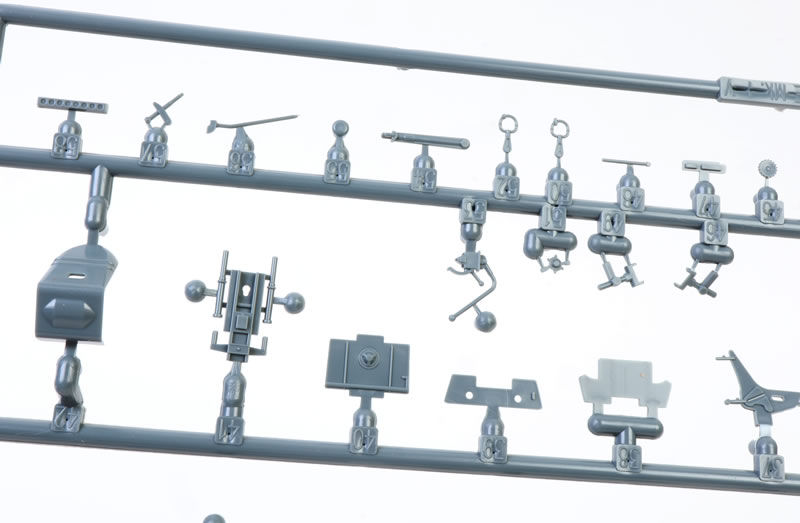
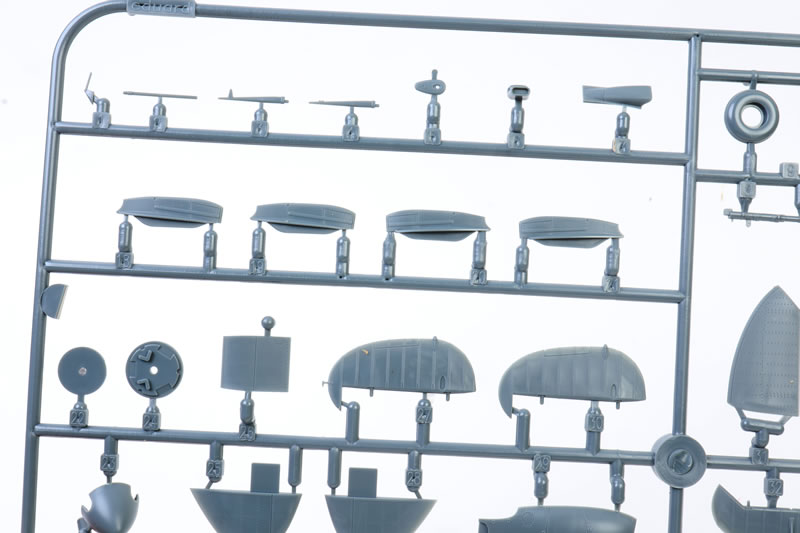
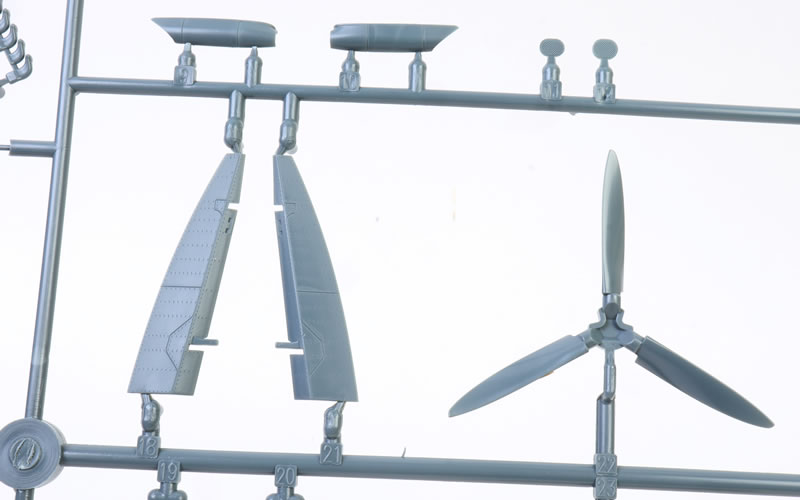
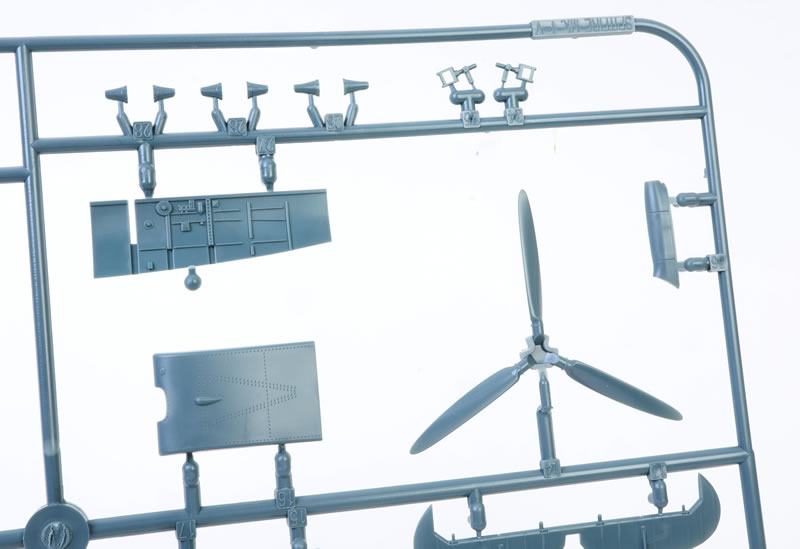
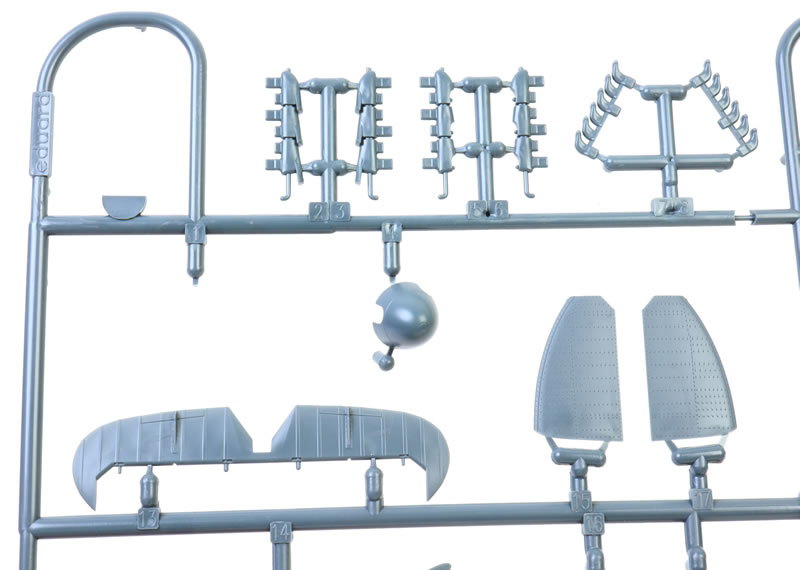
We’ve seen the remaining sprues - P, R and S - in earlier Eduard Spitfire Mk.I, Mk.II and Mk.V releases.
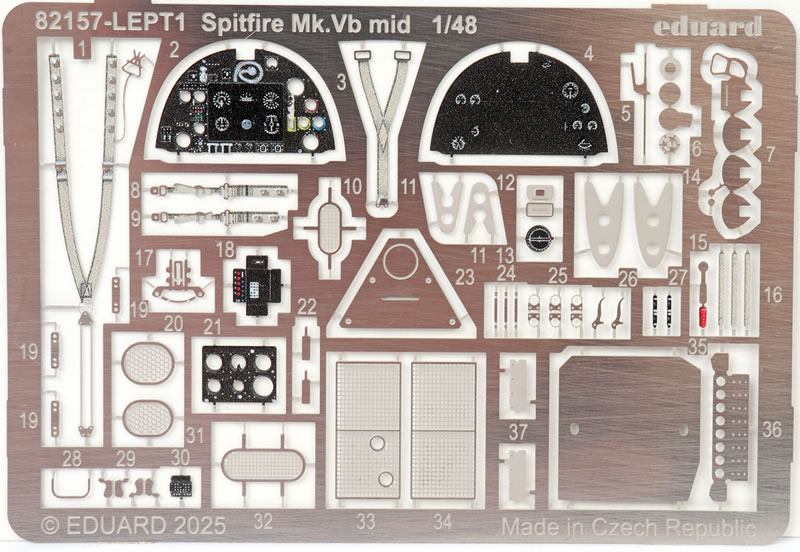
The photo-etched fret focuses on the cockpit with a detailed sandwich for the instrument panel, harness straps and more.
Engineering and Options
The kit is broken down conventionally. The fuselage is full-length with the only insert being the forward wing root.
The lower cowl is separate too.
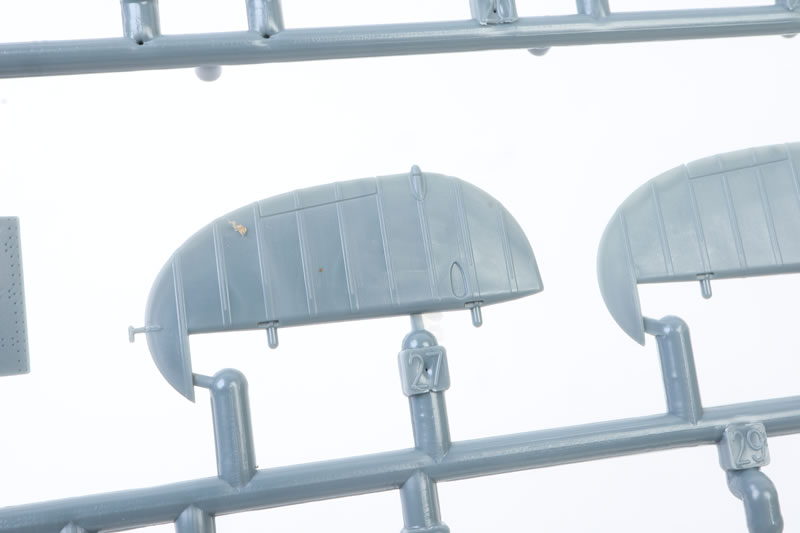
Ailerons, elevators and the rudder are all separate, while the flaps are moulded closed. This is another sensible decision, as the flaps were rarely seen dropped at any time other than on final approach to landing. All flying control surfaces depict fabric covering.
The elevators are moulded as a matched pair, joined in the middle with a plastic connector. This will ensure that the droop (or otherwise) is consistent when the elevators are glued in place.
The canopy side door is a separate part, with the option of posing the door open or closed.
The clear parts are free from distortion and quite thin.
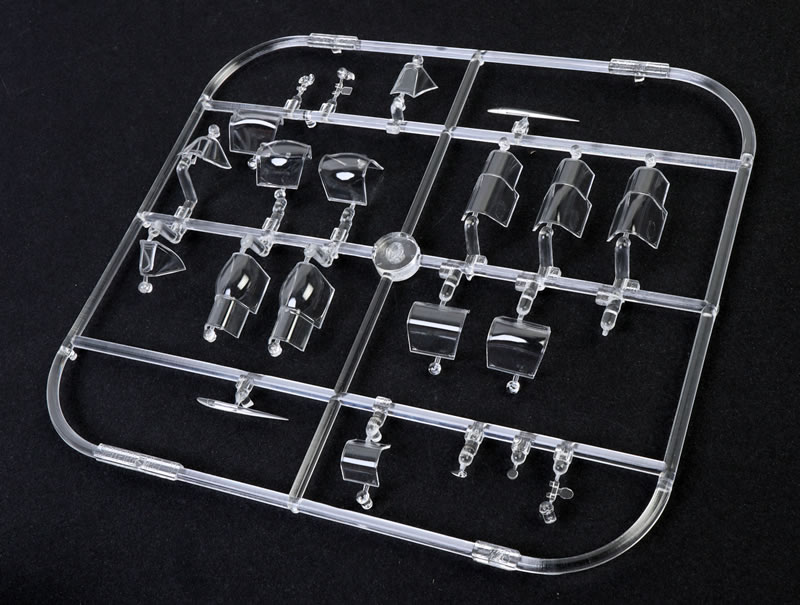
The closed canopy options comprises a combined sliding section and rear section, while the open canopy supplies a separate sliding section to sit over the rear clear part.
Markings
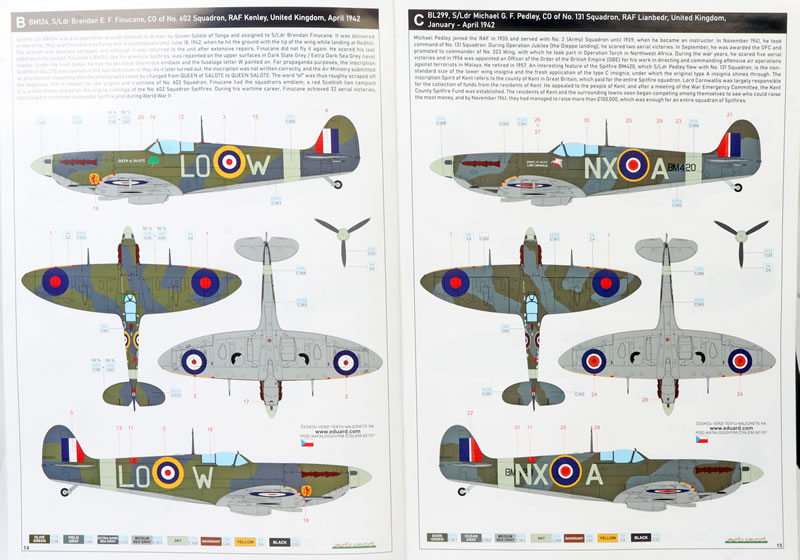
Markings are supplied for seven subjects:
-
BL336, W/Cdr Robert S. Tuck, CO of Biggin Hill Wing, RAF Biggin Hill, United Kingdom, December 1941 - January 1942
-
BM124, S/Ldr Brendan E. F. Finucane, CO of No. 602 Squadron, RAF Kenley, United Kingdom, April 1942. This one features a very interesting scheme that looks uncannily like Temperate Sea Scheme with colours similar to Extra Dark Sea Grey and Dark Slate Grey depicted on the upper surfaces.
-
BL299, S/Ldr Michael G. F. Pedley, CO of No. 131 Squadron, RAF Lianbedr, United Kingdom, January - April 1942
-
BL594, F/O Eugeniusz Horbaczewski, No. 303. Squadron, RAF Kirton-in-Lindsey, United Kingdom, June 1942
-
BL829, F/Lt John Plagis, No. 64 Squadron, RAF Coltishall, United Kingdom, March-September 1943
-
BL547, F/O Rick R. Richards, No. 402 Squadron, RAF Horne, Great Britain, June 1944
-
BL255, Lt. Don S. Gentile, 336th FS, 4th FG, 8th AF, Debden, United Kingdom, November 1942
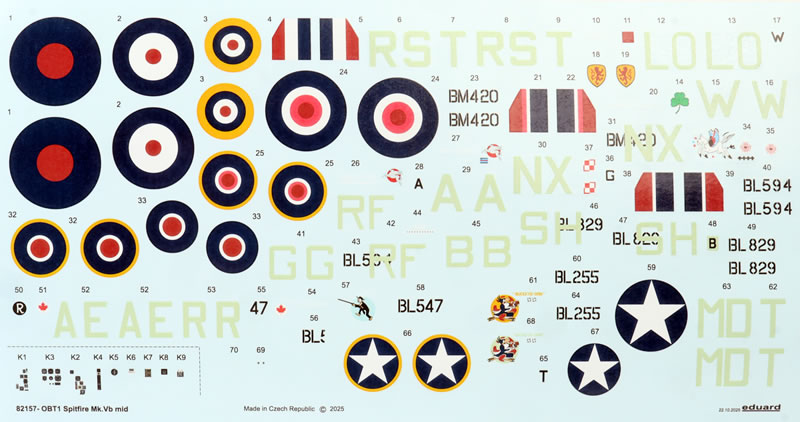
Decals are designed and printed by Eduard. They llook good on the sheet.
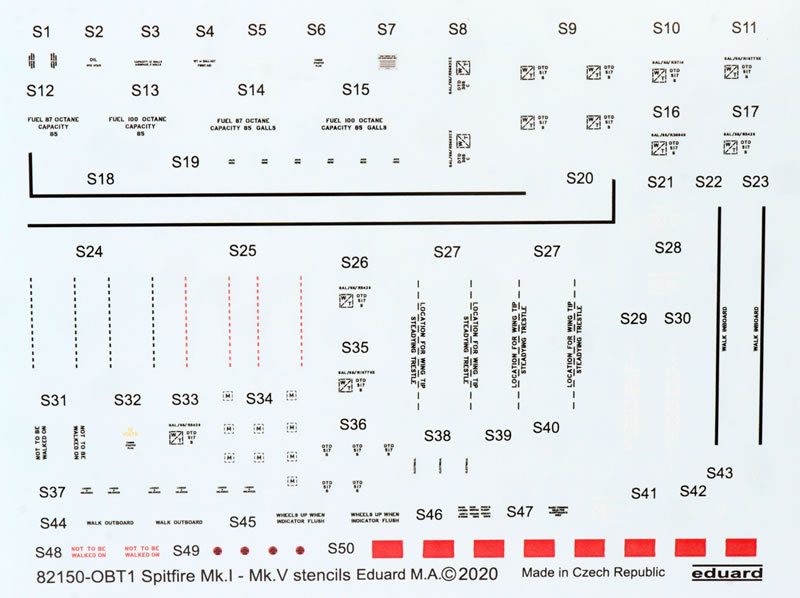
Stencil markings are supplied on a separate decal sheet.
Instrument dial decals, harness straps and red leading edge machine gun patches are on the decal sheet too.
It is nice to see Eduard's gorgeous mid-production Spitfires in this luxurious ProfiPACKguise.
Eduard has lavished well-deserved attention on this vital workhorse.
Eduard’s 1/48 scale Spitfire Mk.V kits are beautifully detailed, accurate, boast lovely fine surface textures and offer most of the options that you will ever need for this sometimes labyrinthine subject.
I have built a number of the ProfiPACK versions of Eduard Spitfires including the Vc and I can confirm that they are a pleasure to put together too.
Eduard’s 1:48 scale Spitfire family has been an instant classic since their initial Mk.IX release and these Mk.Vs maintain the high standard.
Thanks to Eduard for the sample
Review Text and Images Copyright © 2023 by Brett Green
Page Created 20 January, 2026
Last updated
20 January, 2026
Back to HyperScale Main Page
Back to Reviews Page |
 Home
| What's New |
Features |
Gallery |
Reviews |
Reference |
Forum |
Home
| What's New |
Features |
Gallery |
Reviews |
Reference |
Forum |